Taylor Fry is strengthening its commitment to public sector innovation with the appointment of actuary and analytics specialist Jeremy Smith-Roberts as principal and Canberra lead.
Jeremy’s appointment marks the launch of Taylor Fry’s new local presence in the nation’s capital, providing on-the-ground support to its government clientele.
With more than 10 years in government advisory, spanning strategic and operational analytics across welfare, health and disability, national security and Defence, Jeremy will spearhead client engagement in the region. His experience in workforce planning, including the gender pay gap and career pathways, will also assist in broadening Taylor Fry’s offering.
Taylor Fry principal and Sydney-based government lead Dr Hugh Miller says, “Government increasingly seeks to base policy on data and evidence, and our quantitative skillset means we’re well positioned to support this. Jeremy has an exceptional track record of adding that value to government so is a welcome addition to the team.”
Jeremy believes the complexity of government projects requires highly specialised expertise. He says, “It’s critical to have specialist senior staff driving projects, designing solutions and managing that complexity.
“I’m looking forward to continuing to lead applied analytics projects for government. Taylor Fry is known for exceptional commitment to quality data analytics products, services and advice. I’m excited to build on the team of incredibly capable actuaries by growing a Canberra-based presence. We’re focused on supporting the Commonwealth and ACT governments with pragmatic and robust evidence-based advice, and solutions that deliver results.”
Hugh says the new location will yield benefits for Taylor Fry and its government network. “Having a physical Canberra presence will be great for our clients and reflects our growing practice across domains like disability, education, employment and health.
“We also expect the move to Taylor Fry will provide new opportunities for interesting work for Jeremy and the team.”
We evaluated a suite of NSW Government suicide* prevention initiatives, which form part of the state’s $2.9 billion investment in mental health services. By linking state and Commonwealth data, our evaluation offers a rare, system-wide view of suicide prevention efforts in NSW – revealing positive impacts as well as opportunities to improve health responses and community resilience.
The NSW Ministry of Health recently published our evaluation of six programs under the state’s Towards Zero Suicides initiatives – a multi-year effort to reduce suicide and its devastating impact on individuals, families and communities.
Led by Taylor Fry’s Hugh Miller, Ramona Meyricke and Dennis Lam in collaboration with ARTD Consultants, the evaluation brings together a diverse mix of evidence – including linked administrative data, interviews with stakeholders and consumers, surveys and program-level data – to understand how the initiatives are operating and where they can be strengthened.
The six initiatives span the full spectrum of suicide prevention supports:
Safe Havens
Suicide Prevention Outreach Teams
Zero Suicides in Care
Community Gatekeeper Training
Post Suicide Support
am/ Youth Aftercare.
The initiatives reach those who weren’t accessing support or who otherwise wouldn’t have reached out
Initiatives critical in connecting people
Our evaluation found the initiatives are reaching thousands of people across NSW – including those who may not otherwise have sought support. In some districts, more than 40 per cent of Safe Haven visitors reported they would not have sought help had the service not been available. This highlights the critical role these initiatives play in connecting with people who may fall through the gaps in traditional care pathways.
Linked data key in understanding patterns of service use
A key strength of the evaluation was the use of linked administrative data across NSW Health and Commonwealth systems – including emergency, inpatient, mental health, MBS and PBS records. This enabled a more complete view of service pathways before and after engagement with the initiatives, and broader patterns of service use prior to self-harm or suicide. For example, the evaluation found only one-third of people who died by suicide had a recorded interaction with NSW Health mental health services in the year prior to their death. These insights are helping to build a clearer picture of where the system is working well – and where there are opportunities to strengthen access, coordination and follow-up care.
Positive outcomes and service gaps
In terms of outcomes, consumers reported high satisfaction and reduced distress, particularly those accessing Safe Havens, Youth Aftercare and Post Suicide Support. In some districts, Safe Havens were also associated with fewer emergency department presentations for suicidal ideation. At the same time, the evaluation identified important service gaps – and opportunities to improve data capture, referral pathways and access for priority groups, including older people, men and LGBTQIA+ communities.
*The pain and loss of suicide for those who take their lives and the loved ones they leave behind affect thousands of people each year in Australia. If this article raises concerns for you, please contact Beyond Blue on 1300 22 4626, Lifeline on 13 11 14 or seek help from these crisis helplines and support services.
As insurers and governments grapple with increasing extreme weather events and the transition to a low-carbon economy, we’re focusing on how actuaries can contribute meaningfully to solutions, with the appointment of climate and financial risk specialist Dr Ramona Meyricke as head of our climate practice.
Dr Meyricke is the chair of the Actuaries Institute Climate & Sustainability Practice Committee and holds a PhD from Cambridge on the connection between the resilience of supply chains and investment returns in today’s interconnected world.
She brings more than 20 years’ experience in the financial sector, most recently as Director of Policy and Research at IFM Investors, where she led thought leadership, policy advocacy and strategic initiatives, including on climate change.
Dr Meyricke says actuaries are well suited to assessing and managing risk in the climate space
“It has never been more important to understand and manage climate risk and to build resilience – especially in Australia,” she says. “Events like the LA fires and Australia’s east coast floods in 2022 are destroying homes and businesses – they’re challenging communities and pushing up insurance costs.”
As the impacts of climate change worsen, Dr Meyricke adds, efforts to reduce greenhouse gas emissions are falling short of what’s needed.
It has never been more important to understand and manage climate risk and to build resilience – especially in Australia.
For meaningful progress to take place, she believes we must transition the way we go about business and economic activity. “We must build resilience in our society and communities, as well as our businesses and environment.”
She says the actuarial skillset is key. “Actuaries are used to assessing and managing risks to our community that are uncertain, potentially catastrophic and often long term – a perfect combination for us to make an impact in the climate space.”
Taylor Fry co-founder and fellow principal Alan Greenfield says the addition of Dr Meyricke to the team is very exciting. “Ramona was responsible for establishing our climate practice a few years ago, so it’s fantastic to welcome her back as we expand our offering. It’s such a crucial time – for organisations, as they prepare for mandatory disclosures, and for governments, as they ramp up their actions to support achieving net zero.”
He says Dr Meyricke’s experience and collaborative approach will add critical perspective to the challenges ahead. “Ramona’s ability to draw teams together across sectors, combined with her specialist expertise in climate and financial risk, will help organisations identify, measure and manage climate risk, and capture opportunities arising from the economic transition.”
The January fires in Los Angeles are expected to cause tens of billions of dollars in insured losses, with the global reinsurance market integral in covering those losses. What flow-on effects, if any, will this have in Australia? We interviewed a panel of local reinsurers and brokers to find out …
The sheer size of the event is adding to concerns of its effects reverberating around the world
In 2024, the Asia Pacific reinsurance market showed the first signs of premium softening, following large rate increases in 2022 and 2023. In the same month as the devastating Californian fires, January policy renewals continued easing with increased capacity and rate reductions across the global market (see chart below, with data sourced from Guy Carpenter, presented by Artemis.bm). But will this experience continue?
January renewals continued easing along with increased capacity and rate reductions globally
Softening market under pressure
The scale of the LA wildfires raises questions about the potential for flow-on impacts to reinsurer risk appetite and to the expectations of further softening at the 1 July renewals for the Australian market.
Adding to the concern is the sheer size of this event – with estimates of economic loss generally in excess of USD $100 billion and of insured losses up to USD $45 billion – compounded by continuing uncertainty. This includes doubt about the ultimate cost to be borne by insurers (much of the areas affected by the wildfires were underinsured or had no coverage), whether the fire constitutes multiple events, subsequent losses attributable to the fire (e.g. burnt areas having a greater propensity for landslides) and the pace of rebuilding.
What the industry has to say
Reinsurance is a major expense for Australian property insurers, accounting for approximately 30 per cent of premium revenue over the 12 months to 31 December 2024. With this in mind, we interviewed reinsurers and brokers to explore their view on the possible impact of the wildfires on the next renewals at 1 July in Australia.
Overall, there was general agreement that, in isolation, the wildfires were not likely to affect the trend of increasing risk appetite and capacity we’ve seen over the past year. Key factors supporting this view were:
While rates softened over the past year, property reinsurance rates are at an all-time high, providing some level of buffer against a bad start to 2025, with plenty of capacity available at the 1 January renewals
The 2023 market recalibration led to significantly increased rates and a shift to insurers retaining more risk, reducing the burden on reinsurers.
Too early to predict an impact?
Some insurers and brokers we spoke to believed it was too early to predict an impact, with costs and cleanup ongoing as well as uncertainty about catastrophic activity for the rest of the year.
Others indicated the wildfires may slow the pace of rate reductions, while further interviewees said while the wildfires in isolation would not affect market momentum, subsequent events throughout the year may.
In isolation, the wildfires were not likely to affect the trend of increasing risk appetite and capacity we’ve seen over the past year.
APRA mitigation efforts
The Australian Prudential Regulatory Authority is currently consulting on adjustments to its reinsurance settings. In seeking industry feedback (which closed on 17 February), APRA aims to address general insurer challenges to accessing appropriate, cost-effective reinsurance, with proposed changes to the capital adequacy prudential standard GPS116 that may reduce the amount of reinsurance they need to purchase and make Insurance Linked Securities a more attractive option for insurers.
Where to from here – this year and beyond
Many questions remain as to how the wildfires will actually impact 1 July renewals. In our view, experience to date points towards a continued softening market, but perhaps not to the level expected prior to the wildfires. Back home, communities and insurers are starting to assess the damage of ex-Tropical Cyclone Alfred, which may impact reinsurance appetite for Australian exposure at the next renewal.
In the meantime, all eyes are on the 1 April Japanese renewals, which will be the first major renewal to factor in the wildfire impact. Watch this space.
Improved child protection outcomes are among several findings in Taylor Fry’s evaluation of a key government program to strengthen the lives of children, young people and families experiencing or at risk of vulnerability.
Further research in the report – Targeted Earlier Intervention (TEI) Evaluation – released by the NSW Department of Communities and Justice (DCJ), also shows increased sense of belonging in the community, empowerment and self-determination, and health of children and young people.
Co-authored in partnership with Social Ventures Australia and Gamarada Universal Indigenous Resources, we found improvements as well as economic benefits in safety outcomes. This means there was a reduction in concern and risk of significant harm reports as well as exits from out-of-home care. The improvements in safety outcomes translate to $92 million in annual benefits at a minimum.
The report found better safety outcomes with increased access to services early in life and need
The report, Targeted Earlier Intervention (TEI) Evaluation, focuses on the outcomes and economic evaluation of the TEI program. The program aims to prevent the escalation of risks associated with child abuse and neglect by increasing access to services at the most impactful time – early in life and early in need. It also aims to reduce the number of children exposed to the child protection system.
Other findings in our evaluation include:
The proportion of Aboriginal clients who have received services from Aboriginal and/or Torres Strait Islander Community-controlled Organisation (ACCO) providers has increased over time since 2020-21
However, the proportion of funding provided to ACCO providers in 2022-23 was 7.7%, which is below DCJ’s target of 30% in Aboriginal-led early intervention programs
Participation in TEI did not appear to reduce the rate of children entering out-of-home care
Participation in TEI led to increased referrals to key service areas, such as housing, which shows that TEI services are connecting clients to services they need.
Among our seven recommendations detailed in the report, we propose the DCJ increase funding and capacity of Aboriginal and/or Torres Strait Islander Community-controlled Organisations, focus on increasing TEI access in high population-growth and remote areas, and increase flexibility in service provision and provider awareness.
This Final Report builds on our previous Interim Report, which focused on more qualitative aspects of the evaluation.
Escalating premiums, the need for better adaptation responses and a growing cyber market are the big themes capturing insurers’ attention across Aotearoa – all amid a market grappling with increasing regulation. In RADAR FY2024 New Zealand Snapshot, we draw on the most up-to-date data combined with our deep industry insight to find meaning and help market players navigate the future.
Impacts of benign weather
The cascading effects of benign weather in FY2024, following particularly severe natural perils in 2023, include large premium hikes and substantial insurer profits.
Reinsurance costs are a major factor driving the volatile environment, with reinsurers reacting to the previous year’s losses by raising premiums – and the limits at which reinsurance cover starts – effectively passing on their overheads to insurers.
The expectation is for reinsurance rates for property risks to remain at current levels, given the 2024 US hurricane season resulted in two significant events. For New Zealand policyholders, this suggests no substantial relief from insurance premiums due to international factors such as reinsurance costs, for the foreseeable future.
Affordability and transparency top of mind
As prices rise, affordability continues to exert pressure on New Zealanders – premiums are up 20 per cent for all personal insurance lines over the past year, leading to calls from consumer advocates for more transparency on how insurance premium prices are calculated. Home and contents policies have been hit hardest, with the overall percentage rise for personal lines in addition to earlier increases of 15% for home and 10% for contents in 2023.
Rate hikes, particularly on home policies, have highlighted the need to improve adaptation responses
Adaptation key
These challenges highlight the need to improve adaptation responses to the risks arising from natural disasters, particularly as the impact of climate change exacerbates the risks. Efforts are already underway to advance progress. The Climate Change Commission and New Zealand’s Parliament have released reports to variously address areas requiring urgent action in managing costs, providing appropriate resources and ensuring market ability to contain risk. The insurance industry will play a part, but significant input from government is vital.
Regulators focus on customer treatment
Regulators are increasingly focusing on insurers and the fair treatment of customers. Among a raft of changes, the RBNZ is currently revising the Insurance (Prudential Supervision) Act 2010 (IPSA). Industry expects the revised IPSA will enable the RBNZ to undertake more proactive and intensive supervision of insurers. In this environment, it will be crucial for insurers to continue placing policyholders front of mind in every decision they make for their business.
In this environment, it will be crucial for insurers to continue placing policyholders front of mind in every decision they make for their business.
Cyber growing, but take-up slow
On cyber, while New Zealand shares only a fraction of the global cyber insurance market – about NZD $45 million of a total NZD $26 billion in gross written premium – the local cyber market is growing, albeit slowly. Only 8 to 10 per cent of New Zealand businesses are estimated to hold cyber policies, significantly less than peer countries, and this figure is even lower for small and medium-size enterprises.
Cyber risk continues to be a focus for regulators and policymakers in New Zealand – the RBNZ and the New Zealand Government among entities implementing new rules with implications for all general insurers.
We unpack all these key movements, trends and more in RADAR New Zealand FY2024 Snapshot, as the industry seeks solutions not only to meet its challenges head on but to bolster resilience and thrive.
In a new dialogue paper for the Actuaries Institute, Taylor Fry Principal Win-Li Toh and ESG Advisor Sarah Wood, along with co-author Dr Michael Neary of DXC Technology, reveal most small and medium enterprises are not well prepared for a cyber incident.
The paper, Cyber Protection Gap Widens for SMEs, follows two years of several high-profile cyber incidents, an uptick in reported cybercrime, and a raft of government responses and regulation tightening.
Through research and interviews with industry stakeholders, the authors explore the major cyber challenges, impacts and what can be done for SMEs in corporate Australia. It finds that compared to big corporates SMEs have not had similar bandwidth or resources to devote to their cyber security.
SMEs are vital to the Australian economy and the consequences of an attack could be far reaching
The paper revisits the rapidly shifting threat landscape and how it’s changed since the Institute’s 2022 report, Cyber Risk and the Role of Insurance, also by Win-Li and Michael, with Taylor Fry Director Ross Simmonds.
In this latest release, the authors advise that “bridging the cyber protection gap for SMEs will require continued (and relentless) collaboration and effort across government and the insurance industry, as well as within the small business community and the providers of technology solutions that support them”.
They offer five recommendations towards reducing the gap:
Continue to strengthen national cyber defences
Evaluate and scale up education and upskilling initiatives
Make it easy for SMEs to show they take cyber seriously
Consider SMEs’ unique cyber challenges in the upcoming round of Privacy Act changes
Keep the dialogue open between government, the insurance industry and small business.
How is the general insurance industry tracking? Find out in Taylor Fry’s latest annual report, as we share our insights on all the major happenings, trends and impacts on the market in our class-by-class analysis.
For the second year in a row, the industry posted a healthy profit – $3.9 billion after tax – over the nine months* to 30 June 2024. But the solid result comes alongside a sharp focus on industry integrity, with customers and climate the big issues.
Drawing on data from the Australian Prudential Regulatory Authority (APRA), we reveal the healthy industry performance was driven by three main influences – premium increases broadly matching claims costs, catastrophic losses below expectations and steady investment returns of $3.4 billion, up $0.8 billion on last year.
Here’s a snapshot of key themes we explore in RADAR FY2024 …
Focus on transparency, accountability and customer treatment
Actuary and Principal Scott Duncan explores the positive figures against a backdrop of heightened ethical focus. “Some of the key themes driving future industry performance will be transparency, accountability and the fair treatment of all customers,” he says. “The most recent example is the guidance from the Parliamentary inquiry into insurers’ responses to 2022 major floods claims, with its three Ps – policyholder treatment, pooling mechanisms and prioritising preparation.”
Flood inquiry affects whole industry
“Many of the recommendations arising from the inquiry are relevant outside home insurance and the industry is actively considering what this means for other products and processes,” he adds. “As part of the increased focus on customers, senior management and Boards are increasingly demanding information on customer outcomes to complement the usual metrics on financial performance.”
Climate and the race for new technology
Looking ahead, the rapid uptake of AI in business and its climate implications illustrate that the risks insurers face and manage are evolving quickly. “The rise in AI has led to a greater demand for energy, which must be considered in the world’s path to net zero greenhouse gas emissions,” Scott says.
“Insurers investing heavily in AI for business transformation goals will need to consider how this fits in with their net-zero targets and transition planning. They can’t afford not to pay close attention to the shifting landscape, their role within it and the impact on the cover they offer.”
Customers, AI and climate are among the big themes this year, with regulators focused on integrity.
Addressing physical risks only part of the story
He adds that for the industry, building understanding involves recognition that physical risks arising from climate change are only part of the story, that minimising the causes – transitioning to a low carbon economy – is critical to a sustainable insurance future.
“The transition to net zero is undoubtedly changing the risks insurers face and manage,” Scott says. “For example, lithium-ion battery fires and liability exposure from withdrawing too slowly from carbon-intensive industries are top of mind for insurers. But plenty of opportunities exist for insurers within this evolving landscape to innovate and drive the move to a more environmentally and socially responsible society.”
Underinsurance a stark reality
Diving into the classes, the RADAR report shows consumers appear to be turning away from home insurance as cost-of-living pressures bite, with the number of risks insured retreating by around 3% compared with last year. “This is the largest year-on-year drop in insured risks since at least 2013, and follows a 19% year-on-year increase in average written premium,” Scott says. “The growing political focus means insurers must engage more actively with regulators. By providing insights into the practicalities of climate risk pricing, insurers can help shape future regulations, balancing affordability with risk sensitivity.”
Future profitability, he says, will depend on “the level of catastrophic activity and whether recent price increases are sufficient to cover the increase in claims costs, particularly as labour shortages for skilled workers continue to increase repair costs”.
As regulatory changes and media attention on the industry grow, maintaining a positive reputation will be crucial, Scott adds. “Demonstrating a commitment to customer value and community protection, for example through resilience initiatives, will be vital for preserving trust and loyalty.”
The transition to net zero is undoubtedly changing the risks insurers face and manage … But plenty of opportunities exist for insurers within this evolving landscape to innovate and drive the move to a more environmentally and socially responsible society.
Technology changing the nature of car repairs
Turning to Domestic Motor, he says the technology embedded in new vehicles and the shift to electric vehicles are changing the nature of repairs for the industry. “While the cost of spare parts and accessories may have peaked, repair costs are on the rise due to labour shortages and increases in repair times.”
LMI reaps rewards
Reserve releases are another area of interest in RADAR FY2024, which reveals these have had a large impact on 2024 industry performance, with several classes benefitting from a reassessment of prior year claims costs. “Lenders mortgage insurance is a standout class, as the reserves built early in the pandemic continue to be released,” Scott says. “LMI insurers haven’t seen the increase in claims they were expecting due to property price increases, low unemployment and government support during COVID-19.”
The rapid uptake of AI and its climate implications illustrate the risks insurers face are evolving.
Silent AI follows silent cyber
Reflecting on the lessons learned from silent cyber, the Taylor Fry report observes insurers are “getting on the front foot” to clarify coverage and build out underwriting requirements to include questions on the use of AI. “The insurance industry is no stranger to AI and is well versed in the opportunities offered by AI and the potential risks,” Scott says. “The focus now is on understanding the opportunities for new products and how AI changes the risk landscape for existing products.”
*The latest APRA data excludes the September 2023 quarter due to changes in reporting standards.
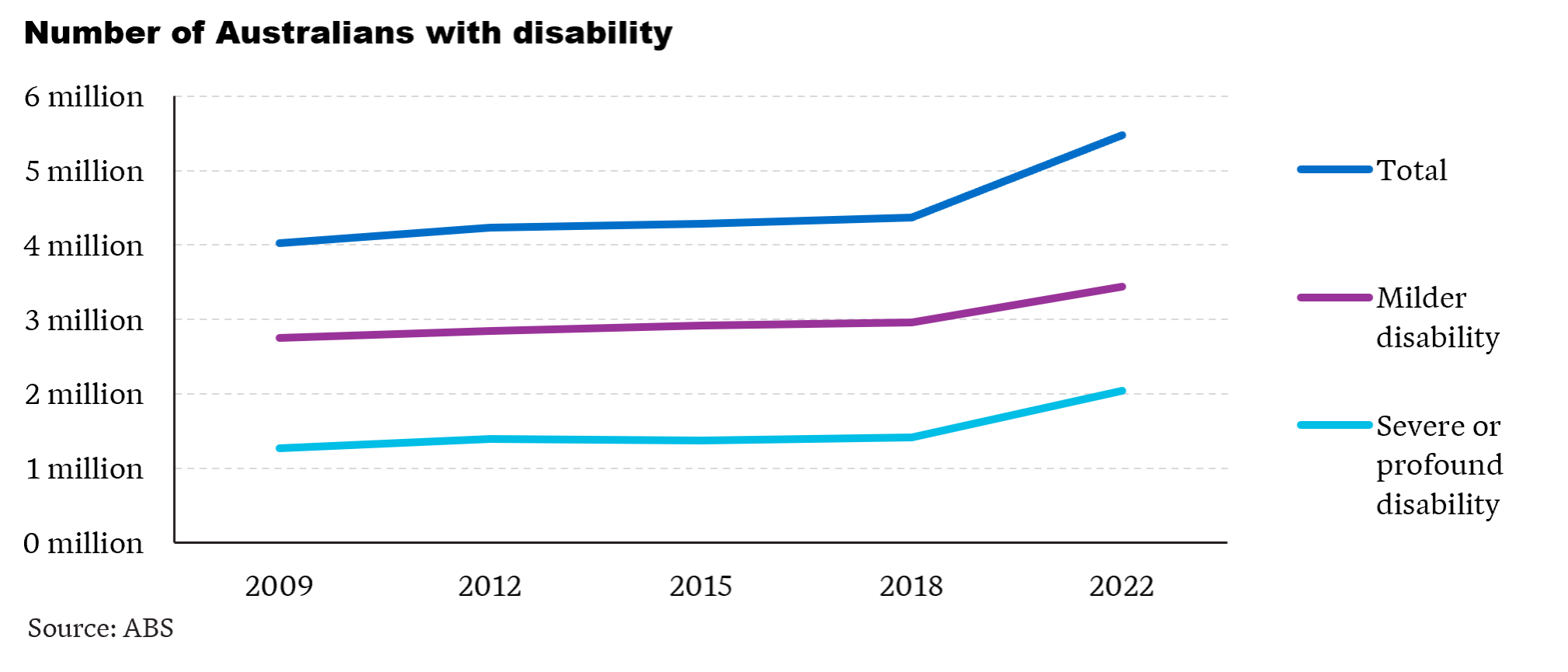
For more than 15 years, the number of people who report having disability has been stable – between 4 and 4.5 million – until now. New data released by the Australian Bureau of Statistics reveals the figure has increased to 5.5 million. We discuss these latest findings and offer some key takeaways for policymakers.
The results of the ABS 2022 Survey of Disability, Ageing and Carers (SDAC) show the number of people with disability rose by 25% from 2018 to 2022. The increase affected most cohorts, but was particularly high for young people and for people with severe or profound disability.
In the survey, the rate of increase in people with disability was highest for young people aged 0-24
What do we mean by ‘disability’?
Under ABS definitions, a person has a disability if they have “any limitation, restriction or impairment which restricts everyday activities and has lasted, or is likely to last, for at least six months”. ABS estimates of disability include:
People with severe or profound disability. People in this group sometimes or always need support with activities such as self-care, mobility or communication. It’s likely many NDIS participants fall into this group.
People with milder disabilities, many of whom are unlikely to be eligible for the NDIS.
A closer look at the numbers
As we mentioned, the total number of people with disability has held steady between 4 and 4.5 million (the dark blue line in the chart), since 2009. In 2022, it rose fairly sharply to 5.5 million.
The rate of increase was higher for severe or profound disability, although there was still a higher increase in the number of people with milder disability than in previous years.
In 2022, the number of people with disability rose fairly sharply, after a long period of stability
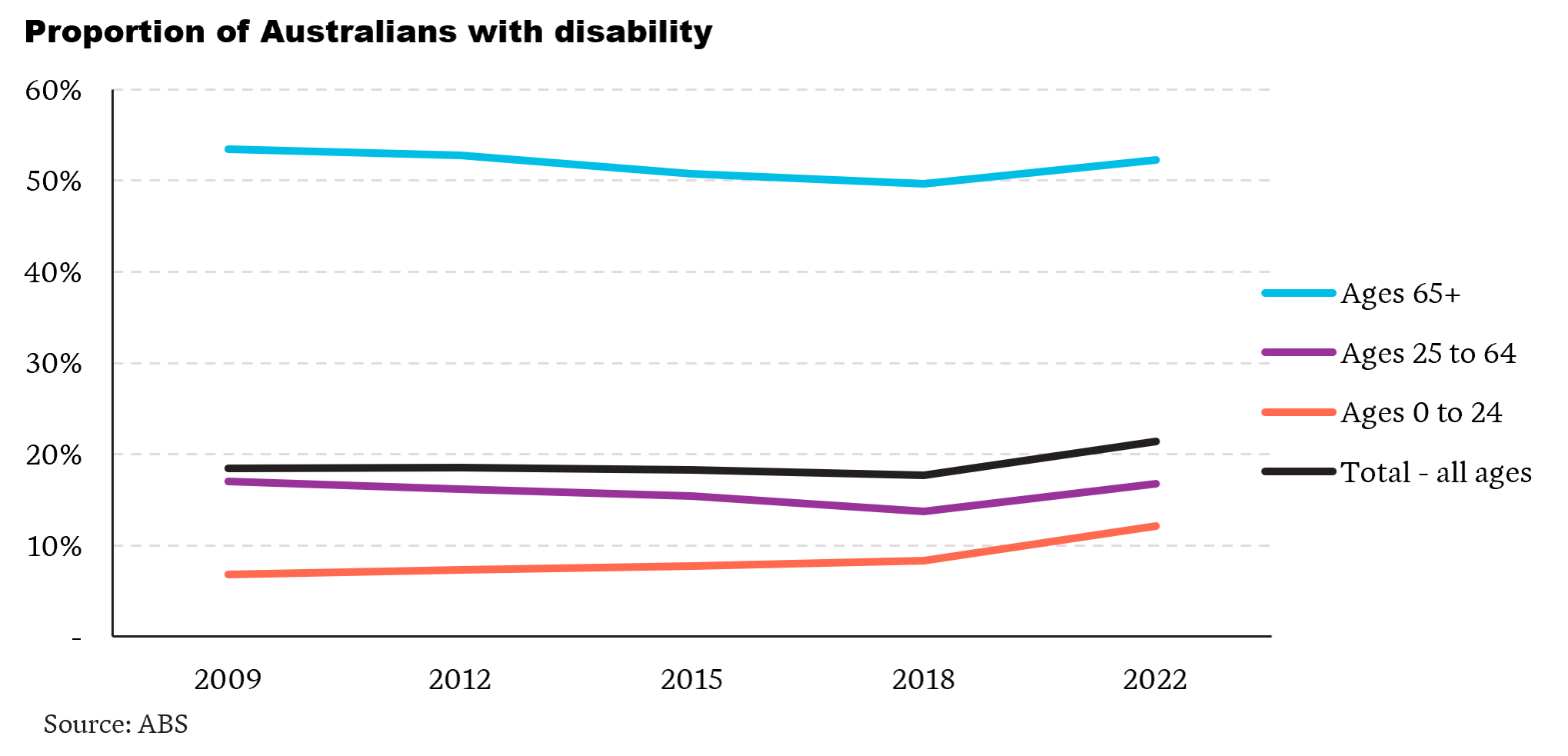
This next chart shows the proportion of Australians in each age group who have disability. Expressing the number of people with disability as a proportion of population allows comparison between age groups.
Overall, the chart shows more people had a disability in 2022 than 2018 across all age groups. The rate of increase was highest for young people aged 0-24. For people aged 25 and above, the rate of disability had been slowly reducing until 2018, but this trend reversed in 2022.
Consistent with past surveys, more than half of people aged over 65 have a disability, as some conditions such as physical disabilities and Alzheimer’s Disease become more common as we age.
The share of those with disability aged 25+ was reducing until 2018. In 2022, the trend reversed
What’s driving the increase?
The ABS identifies four potential drivers of the increase observed in this year’s SDAC:
A growing awareness of disability in Australia
A general increase in prevalence of some disabilities or long-term health conditions
An ageing population
An online, self-completion questionnaire being offered as an option for the first time in 2022.
While it’s not possible to estimate the extent of contribution from each factor, we can make some general observations:
There’s good reason to think awareness of disability would have increased since the last survey (2018). Back then, the NDIS was only part way through its roll-out around Australia. It makes sense that, by 2022, with a fully implemented national scheme and increased media attention, awareness of disability may have increased.
The number of Australians with autism has increased – but more detailed analysis is needed to understand increases in other disabilities or health conditions. The 2022 survey showed a 40% increase in the number of people with autism in Australia, compared to 2018. This aligns with experience in the NDIS – the scheme has seen high growth in the number of people with autism applying each year. While data on other disability types isn’t included in the ABS summary of the survey, more detailed analysis could be undertaken in future to understand how different disabilities contribute to the increase.
The ageing population is relevant, but not the sole driver of the increase. We know this because the increase has affected younger as well as older people with disability.
The ABS has given participants a new way to respond to its survey – an online option – and the impacts of this are unknown. For example, if the ABS online survey made people feel more comfortable disclosing they have a disability, this may have contributed to the increase.
Some key takeaways for policymakers
Among important considerations for policymakers, we’ve identified:
For the NDIS, the survey lends weight to the argument that some of the growth seen to date has reflected increased recognition of disability in the wider community. Unfortunately, the survey won’t tell us what many people want to know – whether or when we might see a slowing of growth in the NDIS.
The recent NDIS Review also recommended strengthening supports outside the NDIS for people with disability, recognising that there is a large group of people with disability outside the NDIS who would benefit from more support. The results of this survey indicate there may be more people who would benefit from these supports than previously thought.
Other survey findings
The SDAC produced a wide range of other important findings – much more than we could cover in this brief article – including:
Information on employment, health, wellbeing and other outcomes for people with disability. For example, the survey shows people with disability have benefitted from the reduced unemployment rate experienced by other Australians in 2022.
For the first time, information on the number of people with disability who have experienced abuse or neglect (complementing the results of other surveys such as the ABS Personal Safety Survey). The SDAC found 11.4% of adults with disability experienced at least one form of physical abuse, emotional abuse or neglect in the past 12 months – underscoring the findings of the Disability Royal Commission in 2023.
With news stories firmly focused on affordability, plus a recent period of benign weather in NZ, a perfect storm may be brewing, as community experience and insurer bottom lines collide. What’s behind the headlines and how did we arrive here? We spoke with Ross Simmonds to find out and explore the impact for insurers.
As premiums rise, underinsured homeowners or those opting to go without insurance may also increase
Rising premiums have been a global issue for some time. What’s the latest on the horizon for the New Zealand insurance market?
From a claims perspective, it’s likely insurers will report significant profits in 2024 – with the costs of natural disasters lower than expected and Tower already upgrading its profit expectations for the year. Insurance Council of New Zealand (ICNZ) data shows the last natural disaster resulting in significant insurance claims was more than a year ago, although the weather events last week in East Cape are likely to break this run.
Why is this experience not reflected in reduced premiums?
Insurance is a complicated balancing act. Insurers set their premiums assuming a level of claims based not on one year’s experience but on the frequency of natural disasters over many years – and in the past decade or so each year has averaged seven to eight events.
Understandably, the community may be concerned about premium affordability and whether insurers have over-corrected. But a single large natural disaster, such as an earthquake or cyclone, can be the difference between a good year and a bad year – which means insurers need to look at claims over a long period.
What other trends are you seeing?
The other major change has been the introduction of risk-based pricing for flood risks. The Auckland floods and Cyclone Gabrielle in 2023 highlighted the widespread damage flood can cause. Risk-based pricing involves using sophisticated models to identify houses most likely to be affected by a flood. This can create hikes in premiums for properties most at risk, even without any recent claims.
What role does reinsurance have in this environment?
The RBNZ, which regulates insurers in Aotearoa, requires insurers to hold high levels of reinsurance to spread the cover for large losses arising from earthquakes. This reflects the high level of seismic risk Aotearoa faces. While the Earthquake Commission (EQC) provides cover for the first $300k, most houses are insured for more. Insurers are required to purchase reinsurance for this additional cover, making reinsurance costs a big component of the outlay for Aotearoa insurers. Based on ICNZ statistics, reinsurance is roughly one-third of the premium for home and contents policies.
… a single large natural disaster, such as an earthquake or cyclone, can be the difference between a good year and a bad year – which means insurers need to look at claims over a long period.
What are the most challenging areas to navigate for the industry?
Affordability is the key issue. There’s a natural tension between insurers wanting to improve their understanding of the risks they face in providing cover to Kiwis against policyholders wanting affordable insurance. For example, as insurers learn more about flood risk, the cost of insurance for high-risk properties becomes unaffordable. Given it’s difficult for an individual property owner to reduce flood risk, they may look to government (local and national) to provide risk mitigation solutions to reduce their premiums.
The other problem linked to affordability is underinsurance, where the insurance payout from a total loss claim will not cover policyholder costs. As insurance costs increase, policyholders may look to reduce their premiums, choosing higher excesses or lower sum insured values. This latter option may result in a policyholder being underinsured. It can create bad publicity for insurers, or even result in regulatory fines if the insurer is found not to have explained the risks to a policyholder of reducing their sum insured.
How are community expectations aligning with insurer or government actions?
Aotearoa has high levels of insurance coverage, especially for home insurance. As premiums continue to rise, it’s likely the number of homeowners who are underinsured (or those with no insurance) will increase. Following large natural disasters, people expect government to provide support in addition to the insurance industry, based on recent buy-back schemes from the Auckland floods and Cyclone Gabrielle. This approach is unsustainable long term, and industry bodies such as the ICNZ are encouraging more investment in resilience measures, rather than the post-event support we’ve seen lately. The recent resilience boost to Northland’s most flood-prone marae, which is almost fully government funded, is a good example of these measures. The industry understands resilience isn’t a simple one-size-fits all solution – rather, it requires careful planning and an individualised approach.
Where are the gaps in reducing risk from an insurer perspective?
The insurance industry would like greater understanding of underlying risks properties face. These are captured by Land Information Memorandums (LIMs) when properties are bought or when new builds are consented. While knowing the risks will help potential buyers, some homeowners are pushing back on this information being included fearing attempts to map areas most at risk may reduce property values. This is the crux of the issue.
The industry also wants more involvement in the consenting-to-build process, to stop housing construction in known bad-risk areas.
Insurers already understand the risks properties face, so whether or not the information is on a LIM, the cost of insurance for high-risk properties is likely to keep increasing. As premiums become less affordable, property values will be affected, as banks require mortgages to be backed by insurance.
The industry also wants more involvement in the consenting-to-build process, to stop housing construction in known bad-risk areas. Currently, insurers are not involved and the insurability of a property is only considered once the property has been built.
How is the government addressing insurance affordability?
Pooled insurance, such as the EQC cover, is designed to keep insurance affordable. In the case of the EQC, this is done by not risk rating for earthquake risk. The EQC premium for a $300K home in Auckland is the same as a $300K home in Wellington. But EQC doesn’t provide coverage for damage to a home due to a flood and given pooled insurance doesn’t reduce the risk of a house flooding, it’s only part of the answer.
The government has also committed $200 million in the 2024 budget which, combined with co-investment from local governments, will accelerate the implementation of 42 flood-resilience projects.
Are there any approaches to insurance affordability in the pipeline?
Large-scale improvements will take time, with small incremental changes being implemented now. Given the scale of the problem, it’s important to recognise significant change can only occur if all parties work together. For example, if insurers provide their insights into existing risks, the government can then identify the most effective resilience investments, which will help improve insurance affordability.
Does experience overseas shed any light on possible actions to take or not to take?
In Australia, the government introduced the Cyclone Reinsurance Pool in 2022, which aims to improve insurance affordability in northern Australia. This partly works due to the nature of cyclone risks in Australia, which tend to impact the northern areas. In this regard, the Cyclone Reinsurance Pool could be considered as similar in design to the EQC in NZ.
Given the scale of the problem, it’s important to recognise significant change can only occur if all parties work together.
In the UK, Flood Re was established in 2016 to make flood insurance more affordable. The scheme excludes homes built after 2009 to avoid promoting development of homes in high-risk areas. In 2022, the scheme introduced its Build Back Better initiative, encouraging risk mitigation for individual properties. This initiative offers householders the chance to install property flood resilience measures up to the value of £10,000 (about NZD$20,000) when repairing their properties after a flood.
At this critical time for the planet, where does climate change fit into the story of rising premiums and profits and the outlook for the industry?
We’re likely to see more weather events, with greater intensity and extremes. Areas not previously considered at risk may slowly become more exposed. This could lead to managed retreat, which has been identified as a climate change adaptation option in the government’s National Adaptation Plan, with insurance potentially the driver for the decision to retreat.
Managed retreat is where an insurer pays out the full sum insured (only if the property has had a significant claim), which the policyholder then uses to buy or build in a better location. This means insurers will stop writing higher-risk properties, which should improve their claims performance in the long term. For other high-risk properties without a previous claim, the insurer would look to stop providing insurance, reducing the value of the property and leaving the homeowner out of pocket. The question of who pays for this loss remains unclear.
What more can insurers do to ensure industry sustainability and provide value to policyholders?
Insurers have absorbed major losses over the past 20 years and they’ll continue to provide protection to Aotearoa homeowners. But they’ll also need to balance their internal risks, with the amount of insurance they provide limited by their capital levels and reinsurance protection. For highly exposed areas, such as Wellington with its earthquake risk, they’ll be able to offer cover only up to specified levels.
More broadly, insurers have an opportunity to contribute by sharing their deep understanding of risk. These valuable insights inform their pricing but could also help government identify the most cost-effective approach to risk protection, whether through mitigation, managed retreat or other solutions.
With all players coming together – insurers, government and local communities – making informed decisions that consider the safety of Aotearoa properties, the insurance industry will continue to strengthen and protect people into the future.